Woodworking Joints and When To Use Them. The 19 plus top joints to use in your woodshop projects from beginner to pro woodworker & everything you need to know.
Once you start your woodworking journey, one of the first things that you will encounter is the various joints used to put a project together. Joining two or more pieces of wood together is critical for making more complex items out of wood. Understanding woodworking joints and when to use them allows you to:
Increase project strength
Improve an item's functionality
Enhance the wood's beauty
Joinery has increased the overall strength of wooden items since man began working with wood thousands of years ago. It increases structural integrity and adds to the amount of weight an item can support. Crafts persons continue to improve the strength of cabinets, furniture pieces, and structures with joinery.
One of the tricks in learning woodworking joints and when to use them is increasing the item's function. Adding joinery provides you with opportunities to adjust shelves, hinges for doors and lids, or modify your shop jigs.
In today's world of plastics or other synthetic materials, building with wood is often done for looks. Joinery offers you the chance to blend wood grain from separate panels, hide joints, and create geometric patterns. Your imagination is the only limit to how many types of wood joints are there for beautification purposes.
Woodworking Joints and When To Use Them
Most cultures around the world have used wood as a building material. Both Asia and Europe have developed a wide range of joinery techniques used outside of those regions.
Some joinery techniques are unique to particular cultures, for example, the intricate joinery used by Japanese carpenters. Other joints are so simple in design or function that they are universal, used for building anywhere that this natural material grows.
Trying to determine how many types of wood joints are there is tricky, as amateurs and professionals alike disagree with categorization. Most joints are either used for carpentry tasks or fine woodworking. The latter group of joinery techniques is the primary focus of most hobbyists, with some carpentry joints used for larger projects or DIY projects around the home.
Included below are less than 20 woodworking joints. They represent the more popular joinery techniques used by woodworkers in their shops, and many of these have slight variations that affect performance.
Woodworking Joints And When To Use Them
How many types of wood joints are there?
Basic Butt Woodworking Joint
For most woodworkers, learning about woodworking joints and when to use them starts with the butt joint. You butt two pieces of wood together to form the joint. Fasteners or glue are applied to hold the pieces of wood together.
The joint does not require any tools outside of those need to install fasteners. You will need clamps if you plan to use only glue to hold the butt joint together (using glue and fasteners provides the best hold).
Skill level needed
The butt joint is one of the easy joints to assemble, making it a favorite for beginners who are just starting. It also offers a quick assembly for simple DIY projects around the home and yard.
Basic Butt Joint – What We Like
It is perhaps the easiest woodworking joint to make
You will need minimal tools to make this woodworking joint
The joint is easy to take apart, especially if you use nails to hold it in place
Basic Butt Joint – Not So Good
The joint is one of the weakest that can be used
It will not hide the edges of half of the boards used to make it
Mitered Butt Woodworking Joint
One thing you will notice with woodworking joints and when to use them is how modifications improve characteristics. The mitered butt joint uses a mitered cut at the end of a board as the point of attachment. That allows you to hide the end grain, improving the overall look of your project.
It does not possess the strength to be used as a supporting joint, but it does allow you to expose wood grain along the sides of an item for an enhanced appearance. A saw and a guide for cutting angles provide the cleanest results.
Skill level needed
The mitered butt joint is another simple design that can be mastered by beginners. Simple projects, like picture frames, make this joint a technique that you can use forever.
Mitered Butt Joint – What We Like
A simple joint that hides the end grain
Requires only a single miter cut on each board's end
Can be made from the same board, allowing the grain to match along each side of the joint
Mitered Butt Joint – Not So Good
You need to cut precisely for the best fit and look
Offers limited holding power, making it useful for decor only
Half Lap Woodworking Joint
One trick with woodworking joints and when to use them is recognizing when more surface area is required. A Half Lap joint removes half of the thickness of wood from the end of your boards. These ends lap over each other, forming a joint equal in thickness to the lumber used.
Adding more contact area in the joint structure provides more gluing surface. The Half Lap is stronger than the Butt Joint, as you do not fasten into the end grain.
Woodworkers will use chisels, planes, or sanders to produce the lap joints, along with their favorite saw.
Skill level needed
The Half Lap is a simple joint that can be used by novices as well as more experienced woodworkers. It is a good option for starter projects and many woodshop jigs.
Half Lap Joint – What We Like
Provides you with more surface contact than a butt joint
Keeps joinery exposure to a minimum on the board's faces
Can be made fairly quickly when compared to other joinery
Half Lap Joint – Not So Good
Requires same thickness on lapping pieces
Less-effective with thicker stock
Tongue and Groove Woodworking Joint
An understanding of function is required when thinking about woodworking joints and when to use them. The Tongue and Groove joint is a great way to connect boards along edges. It provides a more secure fit than simply butting edges up to each other will.
Saws, chisels, and specialized planes can create both the tongue along one edge of a board and the groove on the opposite side. A table saw will speed up the process, with a jig providing easy-to-repeat cuts on the boards.
Skill level needed
The Tongue and Groove joinery require specialized tools or jigs that guide your work as you make cuts on the table saw. Intermediate and advanced woodworkers tend to use the joint more.
Tongue and Groove Joint – What We Like
One of the most effective edge joinery techniques available to woodworkers
Can be used with and without glue
A joinery for use on large surfaces, including floors and walls
Tongue and Groove Joint – Not So Good
The joint is more complicated to make, especially if a tight fit is required
You will need specialized tools or jigs to make the joinery cleanly
Mortise and Tenon Woodworking Joint
Support is critical to think about when selecting woodworking joints and when to use them. Furniture makers learn to create the Mortise and Tenon after grasping basic joinery. The design is useful anywhere that one piece of timber intersects with another at 90-degrees.
Hand tool users will gain proficiency with their chisels making this joint. Power tool users have a distinct advantage here, as a router can make both the mortise and the tenon cleanly, which is critical for making a tight-fitting joint.
Skill level needed
The Mortise and Tenon is an intermediate joint that requires practice to master. Using a router speeds up the process and produces clean results. It can be considered an advanced technique for hand tool users.
Mortise and Tenon Joint – What We Like
Will produce a solid joint that will not come apart
Allows boards to insert into each other, hiding end grain
Can be used to provide structural support to a project
Mortise and Tenon Joint – Not So Good
The joint will take longer to make than other joinery techniques
You will need a router or hand chisels to dig out the mortise
Angled Mortise And Tenon Woodworking Joint
The challenge to woodworking joints and when to use them is mastering your tools and pushing your abilities. The Angled Mortise and Tennon joint require both to produce nice-looking results.
The joinery allows you to insert one piece of wood at an angle into another. Once you have made a few Mortise and Tenon joints, you will know which one is easier for you to make. That will dictate which approach you make; angling the mortise or creating an angled tenon.
Your most important factors here will be your layout and quality marking tools.
Skill level needed
You will need some experience to take the Mortise and Tenon up a notch. Advanced woodworking techniques are necessary to make a functioning Angled Mortise and Tennon joint.
Angled Mortise And Tenon Joint – What We Like
Provides a clean joint for angled wood pieces on items like furniture legs
It can be used to support weight
You can angle the mortise or the tenon to create the joint
Angled Mortise And Tenon Joint – Not So Good
The angle on the mortise or tenon is difficult to create
Woodworkers need patience and good measuring skills
Biscuit Woodworking Joint
Simplicity is the bottom-line for woodworking joints and when to use them, especially for beginners. One method of edge joinery that novices and advanced woodworkers alike use is the Biscuit Woodworking joint.
Both the tool and the wedges are easy to use, making it a quick and efficient way to supplement edge bonding on panel glue-ups. The biscuits provide an additional gluing surface while creating a connection against the grain.
Many woodworkers use the biscuits to help keep boards aligned during the gluing process.
Skill level needed
The biscuit joint is a simple method to learn, as it requires only a biscuit jointer and biscuits. You can master using the specialty tool quickly, as it requires only minor adjustments.
Biscuit Woodworking Joint – What We Like
The joint requires the use of only one tool, a biscuit jointer
It is a joinery method that is quick, especially for edge joinery
A biscuit provides more glue surface for panel assembly
Biscuit Woodworking Joint – Not So Good
The joint requires that you buy a biscuit jointer, which is a specialty tool that does not have a cheap price tag
Some woodworkers argue that the biscuit adds minimal strength to edge joinery
Pocket Woodworking Joint
Jigs figure into your approach to woodworking joints and when to use them. One of the more simple designs is the pocket hole jig.
The device allows you to align and drill pilot holes at an angle into your pieces of wood. You can then use screws to pull pieces together, providing a tight fit that will not come apart easily.
Outside of the jig and drill, you will need to use a clamp to safely hold the jig in place while you work. jigs can come with one, two, or even three holes to make quick work of the assembly process.
Skill level needed
Beginners will find using a pocket hole jig easy. The device allows anyone to assemble their wood pieces quickly and cleanly.
Pocket Woodworking Joint – What We Like
Offers you a fast way to assemble a project
Creates a stronger joint, as the fasteners dig into the wood grain at an angle
It helps to hide the fasteners, as they will remain below the wood's surface
Great for the DIY furniture maker
Pocket Woodworking Joint – Not So Good
Requires a pocket hole jig to make the joint
It also requires that you use screws for assembly
Dado Woodworking Joint
You can get creative with woodworking joints and when to use them, as the Dado joint demonstrates. The joint is made by cutting a groove into one of the pieces of wood. You insert the edge of the other wood into the groove.
The joint is popular with cabinet makers as it provides a way to hold shelving in place without using supporting brackets or other hardware.
Dado stacks, or a wobbling dado blade, can be used in your table saw to make the groove. You can also do multiple passes with a standard saw blade, moving your workpiece over enough to present material for removal.
Skill level needed
A Dado joint is something an inexperienced hobbyist can do with the help of a jig. It is more often used by intermediate and advanced woodworkers, however.
Dado Joint – What We Like
Creates a strong joint for the length of the board
Helps to align boards and provide more gluing area
Great for shelving in bookshelves and cabinets
Dado Joint – Not So Good
You will need a table saw, router, or specialty hand tools
Errors in layout will ruin the joint
Rabbet Woodworking Joint
Location dictates woodworking joints and when to use them. For example, the Rabbet joint is simply a Dado located at the end of your board. The position allows it to fit on the top or bottom of a cabinet. You can also use Rabbet joinery to provide a lip to secure wood to the backside of your project or a ‘groove' dado as a support for a shelf.
It can be easy to mark and layout on boards, and cutting along the end is less challenging than cutting a groove somewhere in the middle of your lumber. Less experienced woodworkers also find it easier to make just one 90-degree cut into the wood instead of creating two crisp 90-degree edges for a Dado joint.
Skill level needed
The joint may be a bit easier for some novices to make than a Dado joint. You can use a saw or chisels to remove the material as well as a specialized Rabbet plane.
Rabbet Joint – What We Like
Provides a dado cut at the edge of your boards
The finished joint is the same thickness as your wood pieces
Can be used to hold a backing piece in place on cabinets or shelving
Rabbet Joint – Not So Good
Can be brittle before you assemble it
Imprecise cuts leave the pieces uneven
Through Dovetail Woodworking Joint
Tradition can play a role with woodworking joints and when to use them. The Through Dovetail joint represents high-level woodworking skills and showcases joinery as with both function and decor.
A good joint for end grain, the dovetails create interlocking fingers that are difficult to pull apart against the wedge shape. The Through Dovetail joint is useful with drawers and other pieces that receive repeated directional loads.
Dovetail saws and chisels are the traditional choices for tools. Routers are the option for today's power tool shop, allowing novices to produce clean results with a dovetail jig. The number, size, and shape of your dovetails are adjustable to provide a decorative look that goes beyond function.
Skill level needed
The Through Dovetail is a joint that woodworkers learn early on but spend a lifetime mastering. Power tools place the joint within the grasp of beginners, but hand tools require intermediate and advanced skills.
Through Dovetail Joint – What We Like
It creates a strong hold to prevent easy separation
The dovetail is suitable for decorative applications
A clean dovetail displays a woodworker's skill
Through Dovetail Joint – Not So Good
Takes longer to create this joinery
Can be difficult for experienced woodworkers
Half Blind Dovetail Woodworking Joint
Small adjustments make a big difference on woodworking joints and when to use them. The modifications provided by the Half Blind Dovetail joint will allow you to hide seams on one half of the joint.
That can be useful when connecting drawer fronts on cabinets or a chest of drawers.
For most, a jig and router will make quick work of this joinery. It can be a challenge for hand tools but is not impossible if you are good with your chisel work.
Skill level needed
The Half Blind Dovetail is a joint that beginners may want to hold off on. Even with power tools, it is better suited for intermediate and advanced woodworkers to produce consistently clean results.
Half Blind Dovetail Joint – What We Like
Effectively hides one side of the joint from view
Maintains the integrity of the Dovetail design
Allow you to connect to pieces like drawer faces without joint seams
Half Blind Dovetail Joint – Not So Good
Creating this joint greatly increases the time needed to make a Dovetail joint
Some components are fragile and can break as you prepare the joint
Half Blind Rabbeted Dovetail Joint
Combining techniques is another example of woodworking joints and when to use them. The Half Blind Rabbeted Dovetail joint is a prime example of this. It provides a rabbeted edge on a board, with Dovetails placed further in on the piece.
You will want a router and jig for this. It will also require a solid grasp of your layout tools. Patience and care are needed to prevent damage to the rabbeted edge. The joint is perfect for drawer fronts, providing a clean edge to the piece while adding dovetail strength.
Skill level needed
The Half Blind Rabbeted Dovetail joint is ideal for advanced woodworking. Beginners will struggle with the layout and cutting on this joinery.
Half Blind Rabbeted Dovetail Joint – What We Like
Combines two popular forms of joinery for a unique look
Allows you to provide a clean edge for pieces like drawer fronts
Displays a high level of woodworking skill and provides a challenge to advanced woodworkers
Half Blind Rabbeted Dovetail Joint – Not So Good
The Rabbet is fragile and can splinter when making the dovetails
It is a complex form of joinery that will take time to make
Sliding Dovetail Woodworking Joint
Ease of assembly can determine the need for particular woodworking joints and when to use them. A joint not used often enough is the Sliding Dovetail joint.
A single dovetail runs the length of your lumber, and a groove runs on the other piece. You then drive the dovetail through until the timber lines up evenly. It creates a strong joint that will not rack out of shape or separate,
You will find the router your best choice for tools. Chisels are usable, but it will take a long time to make (especially the groove).
Skill level needed
A novice can cut the single dovetail and groove needed for this joinery, especially on thinner sections. The difficulty can be making and assembling long portions of dovetails, making it a technique used by intermediate and advanced woodworkers.
Sliding Dovetail Joint – What We Like
Provides a single dovetail for the length of the board
Allows legs and similar stock to slide into place and then break down
Can be used on a wide range of projects
Sliding Dovetail Joint – Not So Good
Can be difficult to align without power tools
Long joints are hard to push together
Box Woodworking Joint
Simplifying an existing design can improve woodworking joints and when to use them. The Box joint is an easy-to-make alternative to the Dovetail joinery discussed previously.
You can use a chisel and saw to make the square fingers by hand. A table saw or hand router is the power tool of choice when making this joinery.
The size or number of fingers can vary, allowing you to create a geometric edge to lumber jointed together in this fashion.
Many woodworkers use the Box joint for connecting plywood or other materials that can peel or separate as you cut. The square design provides the needed connection points to weave the panels together.
Skill level needed
The Box joint is a technique that everyone, including novices, can use. It works well with a variety of materials, including paneling. That makes it an option for beginner projects and woodshop jigs.
Box Joint – What We Like
A simple alternative to dovetails
Provides plenty of surface contact between boards
Cutting the fingers is easy since they have no angles to match up
Box Joint – Not So Good
Is considered less attractive by many woodworkers
Does not offer the natural resistance to pulling that dovetails provide
Butterfly Joint or Bow Tie Woodworking Joint
Repairs are an overlooked aspect of woodworking joints and when to use them. The Butterfly or Bow Tie joint is useful in slowing or stopping cracks in lumber pieces. It can also serve as a decorative inlay on a surface or as a spacer for thinner planks.
A small palm-sized router or chisels creates the impression that the bow tie sits. Most Butterfly pieces are pre-cut using a band saw or passes on a table saw. Components that stand proud of the surface can be planed or sanded flush.
While the idea is simple, the Butterfly or Bow Tie joint is a difficult technique to use. Intermediate and advanced woodworkers use it for decoration or to slow cracks in existing projects.
Butterfly Joint or Bow Tie Joint – What We Like
It can vary in size, depending upon your needs
Can hold pieces of wood apart while providing limited rigidity
You can place this joint in areas where cracks develop to slow them
Butterfly Joint or Bow Tie Joint – Not So Good
Has limited applications outside of decoration
Very difficult to cut cleanly for new woodworkers
Bridle Wood Joint
Another selection on this list of woodworking joints and when to use them includes the Bridle joint. It is a Mortise and Tenon located at the end of your lumber instead of somewhere in between. The bridle joint connects the tops of principle rafter lumber.
The stand out feature on this joinery is the width of joint faces, which match the tenon piece. It allows you to apply ample amounts of glue or several fasteners.
Variations include the Angled Bridle joint that uses a mitered edge on one side of the mortise, offering Bridle joint strength with angles surfaces for picture frames and other decorative pieces.
You can cut the tenon with a saw. The mortise is cut with a saw, and then excess material can be removed with a chisel. A file is useful to clean up the walls for a cleaner fit.
Skill level needed
A novice can take on the Bridle joint with a combination of a saw, chisel, and hand planes. They can also be cut on the table saw.
Bridle Joint – What We Like
Provides surprising rigidity and support
Can easily be reinforced with dowels or fasteners
Lots of glue surface
Bridle Joint – Not So Good
Not the easiest joint to make on thin boards
Needs to be cut full-width on tenon piece
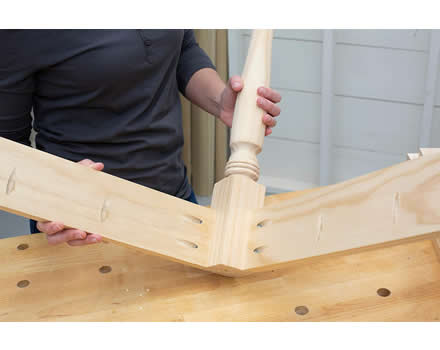
3 Way Miter Joint or Three Way Miter Joint
A Three Way wood joint allows you to assemble more than two surfaces with one joint, a characteristic that is hard to find in woodworking. Once you put it together, it offers a decorative look with angled seams.
Traditionally, saw and chisels shaped the wood on all pieces. You can use drills, table saws, and your router in the modern shop to make the corner wood joints for 3 pieces in a fraction of the time.
In Japanese joinery, the Three Way wood joint was used without glue or fasteners, allowing wood movement and easy repairs.
Skill level needed
Lets say this straight from the get go, the 3 way miter joint is not a simple joint to master well. There are several ways to approach making a three way miter joint all of which require precision and lots of practice. The corner wood joints for 3 pieces can take a lifetime to master with hand tools.
Power tools allow for more precision, but this is still a joint best used by intermediate or woodworkers with a lot of practice and a high level of skill.
3 Way Miter Joint – What We Like
A very strong joint for fastening three components
Provides beauty with the angled faces
Splines add to the structural integrity of this joinery
3 Way Miter Joint – Not So Good
Is difficult to layout for most beginners and intermediates
Surfaces must be precise or the joint will not work properly
Woodworking Finger Joints
The Finger joint is useful in house projects that require two or more boards to join end-to-end.
You might see the thin fingers of this joint and wonder how strong are finger joints? You have to keep in mind that each side of a finger can hold glue, providing more contact area than almost any other joinery used on the end of any board. A mathematical answer to “how strong are finger joints,” places the mechanical strength at 85-percent of a solid board.
You will need a table saw and finger joint jig to make a clean set of fingers on the end of your lumber pieces.
Skill level needed
The Finger joint should be for advanced DIY projects by skilled hobbyists or professionals. Novices can purchase pre-fabricated finger joint boards if they want to try working with the joint.
Finger Joint – What We Like
Provides a solid end-to-end connection for planks
Can add to a decorative theme if various colors of wood are used
Offers more glue surface than other joints designed for end grain
Finger Joint – Not So Good
Fingers are thin and will break easily if forced
Can be difficult to make without a table saw and jig
Scarf Joint – What Is A Scarf Joint?
The scarf joint has been used in construction, ship and boat building for centuries. It can be used effectively for beams, lengthening joists and framing. The scarf joint can be as simple as a plain scarf to complex nibbed and hooked scarf joints with reinforcements.
Many woodworkers are unaware of the scarf joint, so do not feel bad if you ask, “What is a scarf joint used for?” The joinery fastens the ends of the two boards together. It tends to produce a thin glue line, making it popular with intermediate and advanced woodworkers.
You can make a scarf joint by tapering the ends on the lumber you wish to connect. Each taper starts on one face and ends farther down the opposite face of the board. The tapers are opposite one another to allow the pieces to fit together.
What is a scarf joint used for?
The purpose of this joinery is to extend the length of a piece of wood. Standard joints work for decorative components, like molding or trim. Nibs, hooks, or other shapes strengthen joinery used for marine applications as well as timber framing.
How strong is a scarf joint?
The joint has more holding power than a butt joint. You have more gluing surface and area to place fasteners. Dowells or metal fasteners insert through both faces of the joint.
How strong is a scarf joint if you add a hook instead of feathering the ends? The added component naturally resists pulling forces and adds considerably to the overall strength.
Scarf joint vs half lap joint
Selecting between a scarf joint vs half lap joint will come down to looks vs. strength.
Scarf joinery feathers along each end of the boards, helping the glue line to blend. It offers a less secure purchase for fasteners, as one board is thinner than the other along the entire joint.
You will see the glue line on a half lap joint more easily. The glue surface is better as the adhesive sticks along the fibers and not on the ends. Fasteners work better as each board has the same thickness along the entire joint.
Woodworking Joints For Beginners
We all had to start somewhere, and the list of joints above offer challenges for beginners and seasoned woodworkers alike. The key for any novice is to select the basic joints to start. As you gain experience with a handful of projects, you can increase your arsenal to include more advanced joinery techniques.
Woodworking joints for beginners need to require a minimum number of woodworking tools and of course woodworking power tools will help when you start to progress to the more complex joints of want to produce dovetails without using chisels and a mallet!.
That will allow you to purchase your equipment as you need it, without having to shop an entire list to build something fun. These criteria do not eliminate specialty tools; they suggest joints that require few tools to build.
In fact, you probably already have the necessary tools to make several of the joints listed. A beginner's woodshop (or DIY garage) will likely have clamps, drills, saws, and an assortment of measuring instruments.
Woodworking joints for beginners should also be easy to layout. Most joinery on the list below uses simple designs, with an occasional mitered angle or drill hole location requiring marking.
Surfaces on these joints need to be easy to reach for proper cleanup. A joint functions and looks only as good as it fits. Uneven walls rough edges can prevent the joints from coming together.
You also want to use joints that are fast to make. That will allow you to gain confidence in your shop and complete projects quickly. That is important if you have limited time to dedicate to your new hobby.
5 Essential Woodworking joints for beginners
Butt Woodworking Joint
Mitered Butt Woodworking Joint
Dado Woodworking Joint
Rabbet Woodworking Joint
Pocket Woodworking Joint
The 5 woodworking joints for beginners listed above are described in more detail in previous sections on this page. Some require minimal tools (like the Butt joint), while others need specialty tools (a pocket hole jig for the Pocket joinery).
Woodworking Joints – Joining It All Together
If you are new to woodworking, it will not take you long to discover how important joinery techniques and learning how to make accurate woodworking joints are for you projects. From shop items to things around your home, woodworking joints provide structural integrity, function, and looks to your wood.
The 19 woodworking joints we covered are just a small sample of the number of joints that woodworkers use. There are also several modifications to these joints that add other aspects to your build. They are all worth researching.
With a handful of tools and determination, you will soon master the basic designs. From there, you can learn more complex joints to improve your hobby and keep you challenged for a lifetime!
We use cookies to optimize our website and our service.
Functional
Always active
The technical storage or access is strictly necessary for the legitimate purpose of enabling the use of a specific service explicitly requested by the subscriber or user, or for the sole purpose of carrying out the transmission of a communication over an electronic communications network.
Preferences
The technical storage or access is necessary for the legitimate purpose of storing preferences that are not requested by the subscriber or user.
Statistics
The technical storage or access that is used exclusively for statistical purposes.The technical storage or access that is used exclusively for anonymous statistical purposes. Without a subpoena, voluntary compliance on the part of your Internet Service Provider, or additional records from a third party, information stored or retrieved for this purpose alone cannot usually be used to identify you.
Marketing
The technical storage or access is required to create user profiles to send advertising, or to track the user on a website or across several websites for similar marketing purposes.



 Jigs figure into your approach to woodworking joints and when to use them. One of the more simple designs is the pocket hole jig.




Leave a Reply